
A British Airways Airbus A321neo landing at London Heathrow Airport (LHR) from Amsterdam Schiphol Airport (AMS) suffered a dramatic double tail strike as it touched down on runway 27L on Thursday. The incident has subsequently gone viral, as it was caught on a popular online livestream. The aircraft has subsequently been taken out of service for a short period.
This grounding appears to be only temporary, with the jet set to be back in the air as soon as Saturday. Nonetheless, it clearly needs the kind of inspections that can’t be undertaken during a usual turnaround between flights. After the tail strike, the aircraft went around, resulting in a longer-than-usual flight time on the route from Amsterdam to London, which typically takes less than an hour.
The flight in question was BA431, which was operated by G-TNEB. According to ch-aviation, this jet is almost three years old and is one of 20 A321neo units in the carrier’s fleet. Data from Flightradar24 shows that it was scheduled to leave Schiphol at 10:20 AM on Thursday, but took off at 10:45 AM. Its first landing attempt at LHR was 50 minutes later, at 10:35 AM local time.
The first landing attempt didn’t exactly go to plan, with the jet suffering a dramatic double tail strike as it touched down. The incident unfolded on a BigJetTV livestream, with a clip of the double tail strike having since amassed some 213,000 views on the YouTube channel. The Air Accidents Investigation Branch is looking into the matter.
British Airways confirmed the aircraft ultimately “landed safely,” but could not “comment further” on the incident.
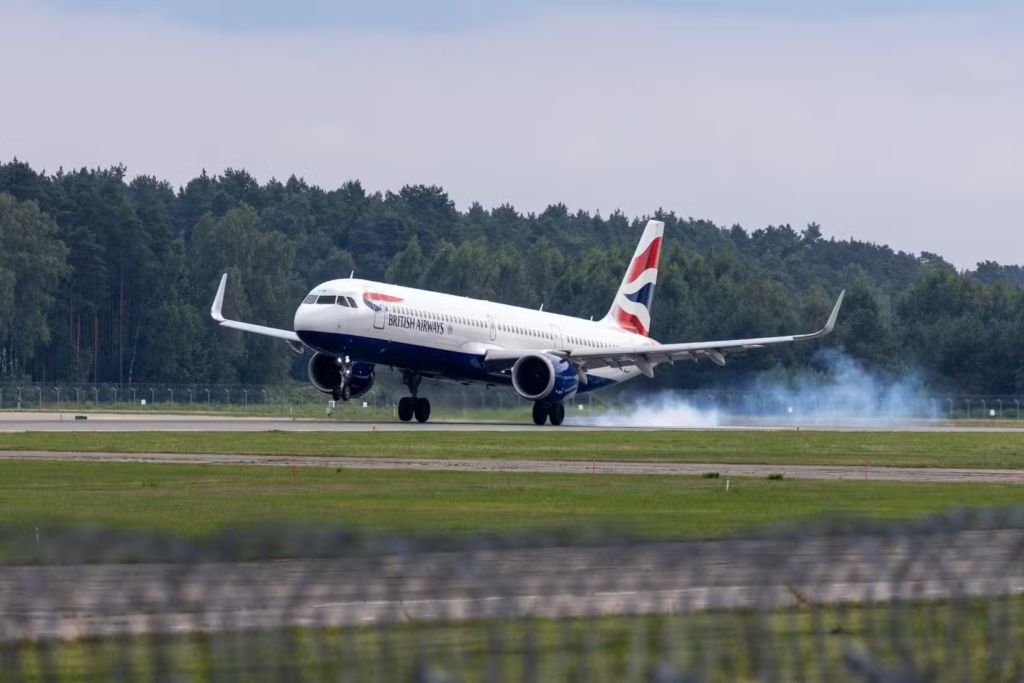
As is often the case when an aircraft suffers a tail strike on landing, the crew of BA431 opted to go around and take a second crack at the landing. According to Simple Flying’s Flight Tracker, it climbed away to the left after its aborted touchdown, reaching a maximum altitude of 4,000 feet as it circled back around for a second approach to runway 27L.
As noted in the carrier’s statement, this second attempt saw the jet land safely, turning back over Beckenham and rejoining the approach path near Brixton. It ultimately touched down at 10:50 AM local time, some 15 minutes after its first landing attempt. This meant that the flight was in the air for an hour and five minutes overall, making it much longer than the usual rotations on BA431.
According to Flightradar24, passengers on this service can generally expect to be in the air for around 50 minutes, with the quickest run so far this month being a 45-minute hop on November 3. In fact, before yesterday’s incident, it had been three weeks since BA431 spent more than an hour in the air, with October 22’s rotation a 67-minute affair because it had to circle twice on approach.
Tail strikes can cause serious damage to the rear of an aircraft, such as an Airbus A300-600F, which had to be written off after an incident at LHR in October 2025. With this in mind, airlines often temporarily ground aircraft in such situations in order to carry out inspections and, if necessary, repairs. This was the case for G-TNEB, which hasn’t flown since BA431.
Data from Flightradar24 suggests the jet will remain out of service all day Friday, as it has not been rostered to operate any more flights until Saturday morning. As it stands, it is scheduled to operate a morning rotation from London to Inverness and back, followed by an afternoon round trip to and from Amsterdam. Its fifth and final flight will see it travel to Warsaw.