

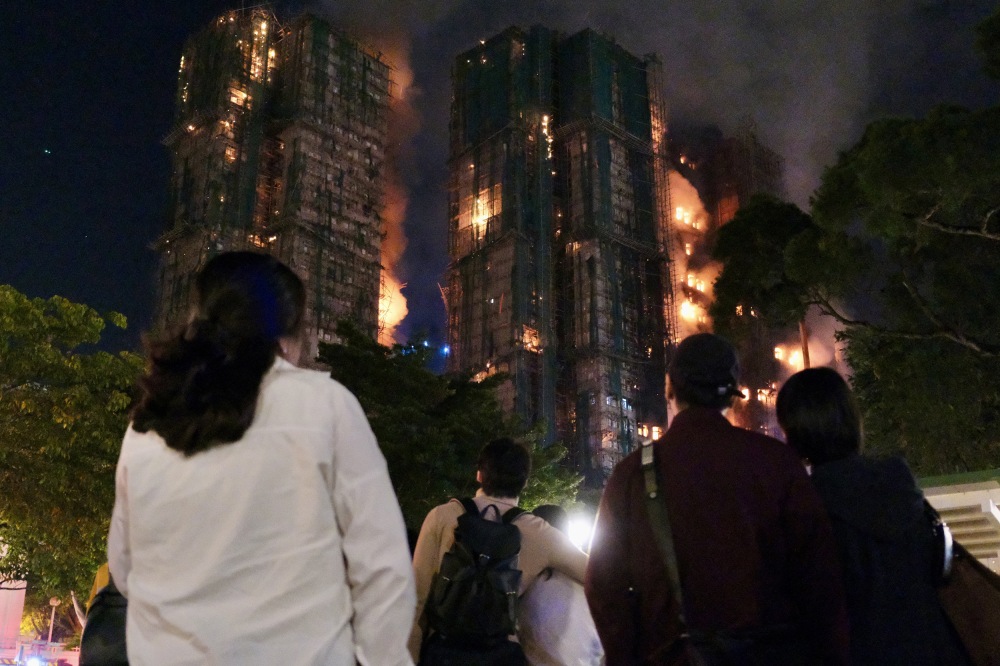
HONG KONG — A major fire tore through multiple high-rise towers at a housing complex in Hong Kong on Wednesday, killing dozens of people, the city’s chief executive, John Lee, said, with 279 people still unaccounted for.
Twenty-nine others were being treated in hospitals, seven of whom were in critical condition, after the fire broke out at Wang Fuk Court in the northern district of Tai Po.
Three people, aged between 52 and 68, were arrested on suspicion of manslaughter, Reuters reported, citing Hong Kong authorities, and the death toll had risen to 44 by early morning local time.
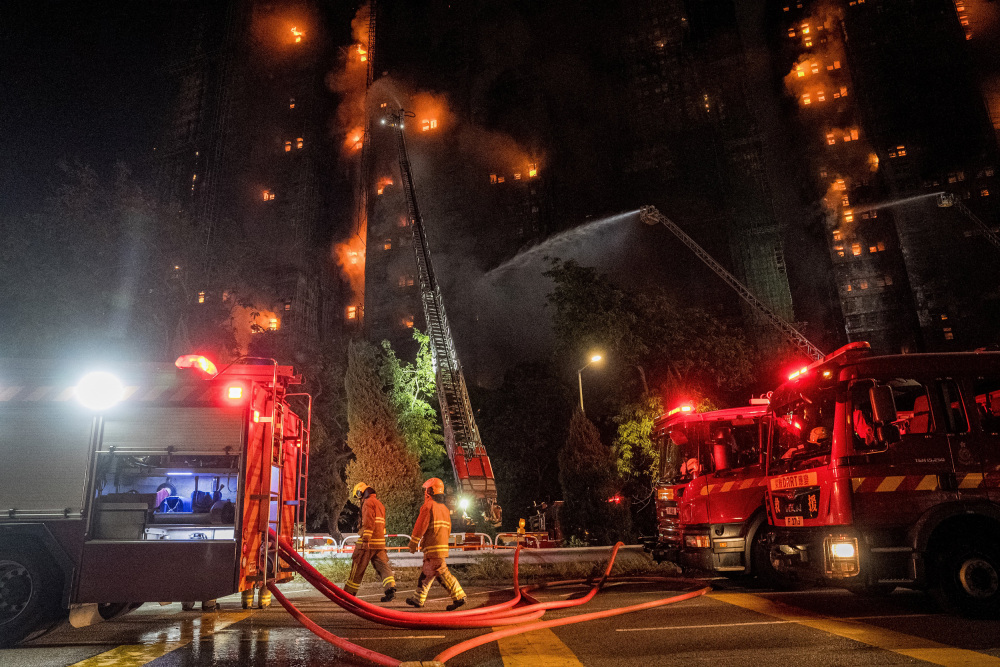
The fire in four of the residential buildings in the complex was under control by early morning local time, Hong Kong authorities said, according to Reuters.
Massive flames and thick plumes of dark smoke could be seen coming from multiple towers at the housing complex, which opened in 1983 and has almost 2,000 residential units across eight buildings.
Harry Cheung, 66, who has lived in the area for more than 40 years, told Reuters he heard a loud noise and saw fire erupt in a nearby block.
“I immediately went back to pack up my things,” he said.
“I don’t even know how I feel right now,” he said. “I’m just thinking about where I’m going to sleep tonight, because I probably won’t be able to go back home.”
A resident who provided only her surname, Wu, told local TV station TVB: “I’ve given up thinking about my property. Watching it burn like that was really frustrating.”
The city will “provide all possible resources,” Lee said as he offered “deepest condolences to the deceased and heartfelt sympathy to their families and the injured.” Hong Kong’s housing secretary, Winnie Ho, said 1,400 apartments would be made available across the city for those who were displaced.
The fire broke out Wednesday afternoon and was upgraded to the highest-level alarm in the city at 6 p.m. local time (5 a.m. ET). Firefighters were still battling it as night fell.
Lee told reporters shortly after midnight that the fire was “coming under control” and that the fire service of Hong Kong had “sufficient manpower and capability” to extinguish it.
Bamboo scaffolding had been erected outside several towers as they underwent renovation, local media reported, and the city’s security secretary, Chris Tang, said buildings had “protective netting” on exterior walls. “Once ignited, the intensity and speed of the fire’s spread were far greater than that of materials meeting safety standards,” he said. “We consider this to be unusual.”
Styrofoam boards that “spread fire very easily when exposed to heat” were also discovered placed against windows in a building inside the complex that was unaffected by the fire, he said.
Falling debris and the scaffolding impeded rescue efforts, Derek Armstrong Chan, deputy director of Fire Service operations, told The Associated Press. He said: “The temperature inside the buildings concerned is very high. It’s difficult for us to enter the building and go upstairs to conduct firefighting and rescue operations.”
Chinese President Xi Jinping sent condolences. Hong Kong, one of the most densely populated cities in the world, is a special administrative region that maintains a degree of autonomy from China.

The fire is the city’s deadliest since 1996, when flames ripped through a commercial building in the heart of Kowloon, killing 41 people.
Firefighter Ho Wai-ho, 37, was among the dead. He “sustained burns to his face,” Fire Services Director Yeung Yan Kin said at a news conference Wednesday, adding that he was rushed to a nearby hospital, where he later died.
“I would like to extend my deepest condolences to firefighter Ho’s family,” he said, adding that another firefighter was being treated for heat exhaustion.
Civil Service Secretary Ingrid Yeung praised Ho’s “gallantry and selfless devotion to duty” in a statement and said officials will “make every effort to help the family of Mr Ho during this sad and difficult period.”
Hong Kong has been under a red fire danger warning since Monday, which means there is an extremely high risk of fire due to recent warm weather conditions.